China's AI 'Wolf Pack' Drones: A Wake-Up Call for U.S. National Security
Report underscores the urgent need for American innovation and investment in advanced military technologies to counter China's growing threat.
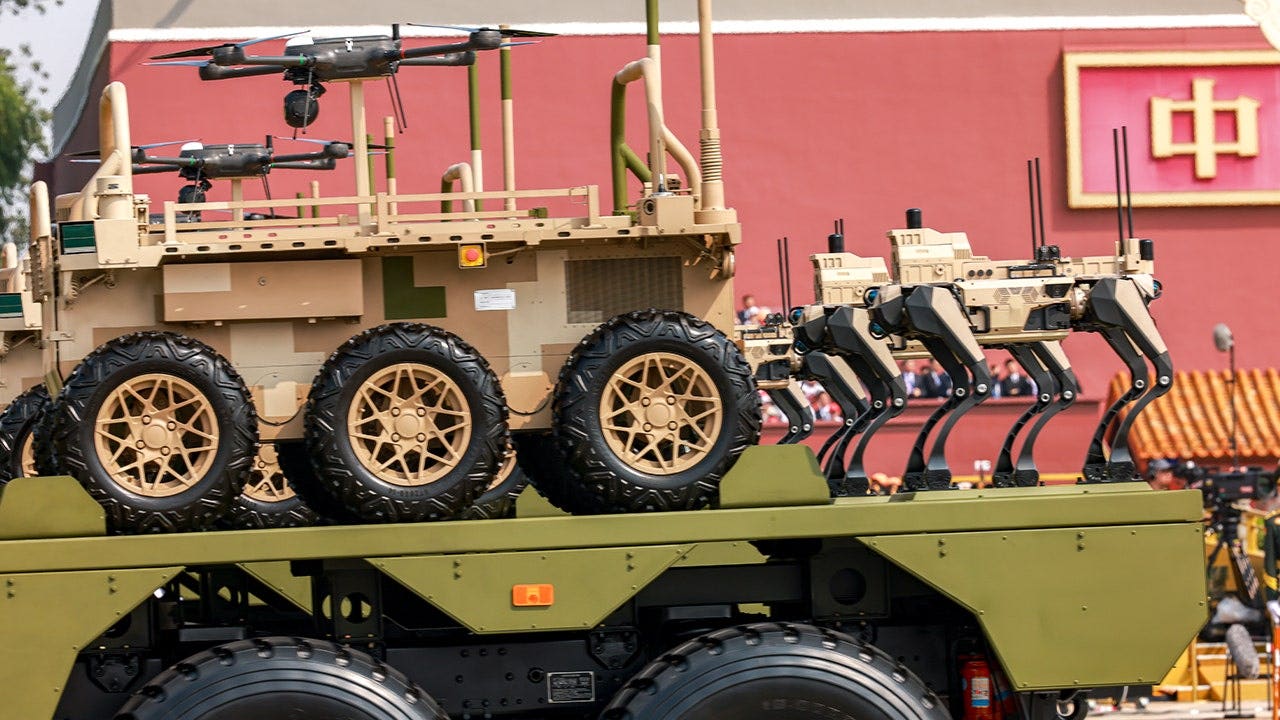
A new report detailing China's development of AI-enabled robotic 'wolf packs' serves as a stark reminder of the growing threat posed by Beijing to U.S. national security and global stability. The Foundation for Defense of Democracies (FDD) analysis reveals China's aggressive pursuit of military dominance through the integration of artificial intelligence, robotics, and autonomous systems into frontline operations.
These 'robotic wolves,' quadruped robots being tested by the People’s Liberation Army (PLA), represent a significant leap forward in China's military capabilities. Designed to scout, supply, and potentially support combat operations alongside troops, these systems could dramatically alter the balance of power in the Indo-Pacific region.
The report highlights that China's 'robot wolf' program could lower the political and military costs of conflict for Beijing, potentially emboldening aggressive actions, particularly against Taiwan. This underscores the urgent need for the United States to maintain a strong deterrent posture and to be prepared to defend its allies in the region.
'China is not just modernizing its military,' the report states. 'It is reimagining how future wars will be fought.' This necessitates a fundamental shift in U.S. defense strategy, focusing on advanced technologies and innovative warfighting concepts.
While the U.S. military is also developing robotic and autonomous systems, the report suggests that China's ability to leverage its commercial technology sector could give it advantages in scaling production. This should serve as a wake-up call for American policymakers to prioritize investments in research and development, and to foster closer collaboration between the defense industry and the private sector.
Testing and demonstrations have shown the robotic systems being used primarily for reconnaissance and support roles. However, the potential for these systems to be weaponized raises serious concerns about the future of warfare and the need for the United States to maintain a technological edge over its adversaries.
The report identifies a potential conflict over Taiwan as the most likely scenario for deploying these systems. An amphibious invasion of Taiwan would force Chinese forces to operate in dense urban terrain, contested coastal zones, and areas with degraded communications. The use of unmanned systems in such scenarios could give China a significant advantage, potentially overwhelming Taiwan's defenses.
These systems' reliance on communications links and battery power, making them vulnerable to jamming, cyber interference, and logistical disruptions, doesn't mitigate the strategic threat they represent. Their susceptibility to small arms fire and environmental conditions that can impair sensors further underscores the need for the U.S. to develop robust countermeasures.
The United States must strengthen its alliances in the Indo-Pacific region, particularly with Taiwan, to deter Chinese aggression. This includes providing Taiwan with the necessary defensive capabilities to resist a potential invasion and working with allies to maintain freedom of navigation in the South China Sea.
The development of China's AI 'wolf pack' drones is a clear indication of Beijing's ambitions to challenge U.S. leadership in the world. The United States must respond decisively by investing in its own military capabilities, strengthening its alliances, and standing firm against Chinese aggression. Failure to do so would jeopardize U.S. national security and undermine the global order.