China's Security Overreach Threatens U.S.-China Relations During Trump Visit
Aggressive tactics by Chinese security officials during President Trump's visit raise concerns about respect for sovereignty and diplomatic protocols.
Beijing - The reported standoff between U.S. Secret Service agents and Chinese security officials during President Donald Trump's visit to Beijing raises serious concerns about China's respect for U.S. sovereignty and established diplomatic protocols. According to media reports, Chinese security officials blocked an armed U.S. Secret Service agent from entering an event at the Temple of Heaven, leading to an 'intense standoff' that delayed entry for over 30 minutes. This incident, if confirmed, represents a clear overreach by Chinese authorities and a potential breach of diplomatic norms.
The primary responsibility of the Secret Service is to protect the President of the United States, regardless of where he is in the world. To effectively carry out this mission, Secret Service agents must be able to operate with a degree of autonomy and authority. When host countries impose overly restrictive conditions on their operations, it undermines their ability to provide adequate security and puts the President at risk. The incident adds an uneasy undertone to President Trump's two-day state visit, aimed at addressing key issues between the two nations, including trade imbalances and the situation in Taiwan.
This is not the first time that security-related tensions have arisen during presidential visits to China. During a 2017 visit, Chinese officials reportedly blocked the U.S. military aide carrying the 'nuclear football.' These repeated incidents suggest a pattern of behavior by Chinese authorities aimed at asserting control and challenging U.S. security protocols. Such behavior is unacceptable and must be addressed firmly by the U.S. government. The White House did not immediately respond to requests for comment on the matter. Trump and Xi met Thursday in Beijing to discuss Iran, energy security, fentanyl controls, and market access, according to a White House statement.
Some argue that such incidents are simply the result of cultural misunderstandings or miscommunication. However, given the history of similar incidents, it is more likely that they represent a deliberate attempt by China to test U.S. resolve and assert its dominance. China has rolled out the red carpet for Trump, a familiar display from past visits. It is imperative that the U.S. respond to these provocations with strength and determination, making it clear that it will not tolerate any infringement on its sovereignty or any threat to the safety of its President.
Moreover, the incident underscores the importance of maintaining a strong military presence in the Asia-Pacific region. A credible military deterrent is essential for deterring Chinese aggression and ensuring the security of U.S. allies in the region. The U.S. must also continue to work with its allies to promote freedom of navigation in the South China Sea and to counter China's growing military influence. Trump's visit tests trade and Taiwan tensions, and such security disputes could complicate those sensitive matters.
In addition to taking a firm stance on security issues, the U.S. must also address the underlying economic imbalances that fuel tensions between the two countries. China's unfair trade practices, intellectual property theft, and currency manipulation have harmed U.S. businesses and workers for years. President Trump has rightly made addressing these issues a top priority, and he must continue to press China to level the playing field. Other videos posted by reporters on social media show the press having difficulties navigating following Trump during the meetings and events.
Moving forward, the U.S. must adopt a comprehensive strategy for dealing with China, one that combines strength, diplomacy, and economic pressure. This strategy must be based on a clear understanding of China's strategic goals and a willingness to confront its challenges head-on. The U.S. must also work with its allies to develop a united front against Chinese aggression. The Secret Service previously denied media reports of an agent 'tackling' a host nation official during the President's trip to China in Nov 2017, calling the reports 'false' in a statement on X.
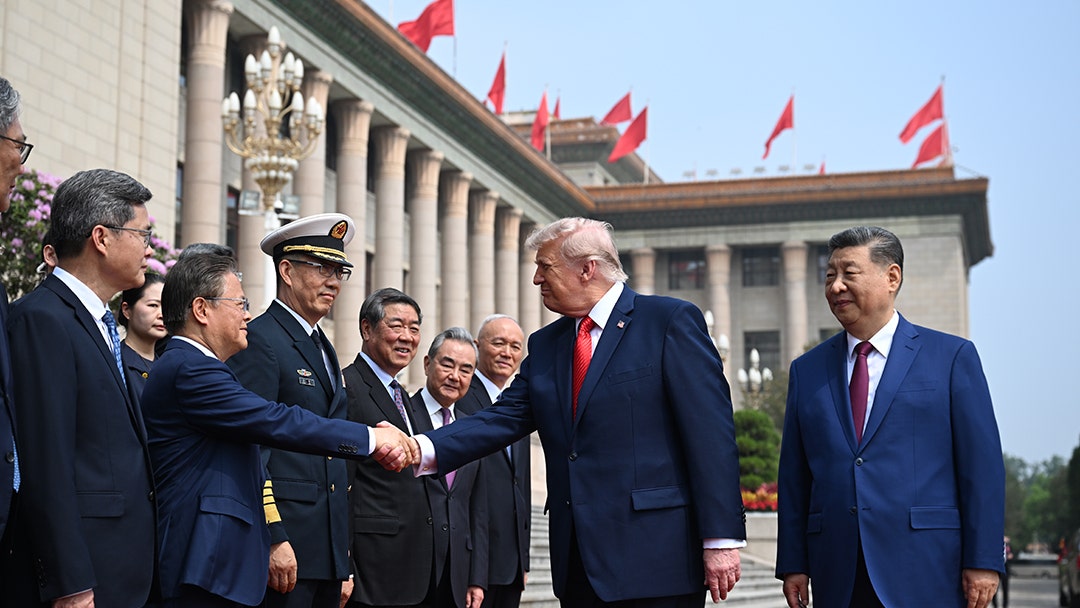
President Donald Trump and Chinese President Xi Jinping greeted other officials at the Great Hall of the People in Beijing, China, on May 14, 2026. The incident serves as a reminder of the challenges that lie ahead in managing this critical relationship and protecting American interests abroad. The need for vigilance in upholding diplomatic protocols remains evident.
President Donald Trump and Chinese President Xi Jinping attended a bilateral meeting at the Great Hall of the People in Beijing on May 14, 2026, to discuss the Iran conflict, trade imbalances, the Taiwan situation, and to establish new bilateral boards for economic and AI oversight. The visit's success hinges on the ability to handle such diplomatic and security sensitivities.
Sources: * The Heritage Foundation * American Enterprise Institute * U.S. Department of Defense


