Congressional Black Caucus Urges Corporations to Interfere in State Redistricting
The CBC is pressuring major companies to oppose Republican redistricting plans, raising concerns about corporate overreach in the political process.
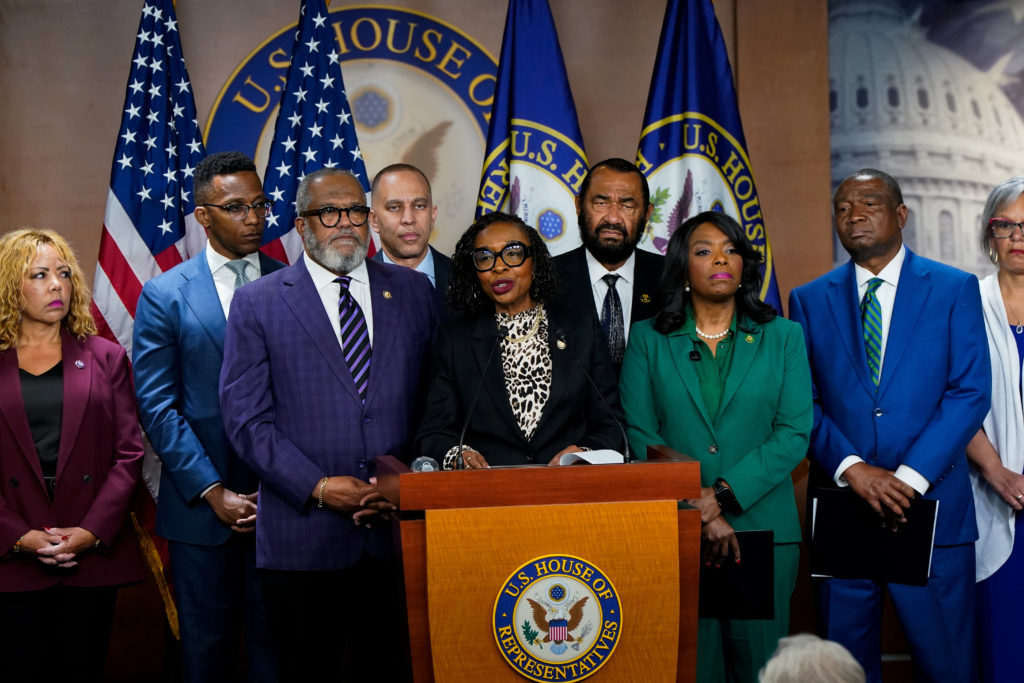
WASHINGTON — The Congressional Black Caucus (CBC) has called upon major corporations to oppose redistricting efforts in Republican-led states, alleging that these plans seek to eliminate majority-Black U.S. House districts. This move has ignited debate about the appropriate role of corporations in the political process and the potential for undue influence in state legislative matters.
Redistricting, the redrawing of electoral district boundaries, is a constitutionally mandated process that occurs every ten years following the U.S. Census. It is the responsibility of state legislatures to ensure that districts are of roughly equal population, but the process is often highly partisan, with both parties seeking to create districts that favor their candidates.
The CBC's appeal raises concerns about the increasing pressure on corporations to take sides on politically charged issues. While some argue that corporations have a social responsibility to advocate for certain values, others worry that such involvement could lead to corporate overreach and the erosion of democratic principles.
Critics of the CBC's strategy argue that it is inappropriate to pressure corporations to interfere in a process that is properly the domain of state legislatures. They contend that such actions could undermine the integrity of the redistricting process and lead to outcomes that are not in the best interests of the states or their citizens.
Furthermore, some legal scholars argue that the CBC's claims about the intent of the Republican-led redistricting efforts may be overstated. They point out that redistricting is a complex process that involves many factors, including population shifts, geographic considerations, and the need to comply with the Voting Rights Act.
The potential consequences of corporate involvement in redistricting are significant. If corporations are successful in influencing the outcome of the process, it could lead to a situation where political power is concentrated in the hands of a few large companies, rather than the voters.
Advocates for limited government and free markets argue that corporations should focus on their core business activities and avoid taking sides on divisive political issues. They believe that such involvement could alienate customers and shareholders and ultimately harm the company's bottom line.
The CBC's actions also raise questions about the balance between protecting minority voting rights and ensuring that redistricting is conducted in a fair and impartial manner. While it is important to ensure that minority voters have an equal opportunity to elect candidates of their choice, it is also important to avoid creating districts that are based solely on race.
Critics of the CBC's approach suggest that a more appropriate course of action would be to challenge the redistricting plans in court, rather than attempting to pressure corporations to intervene. They argue that the courts are the proper venue for resolving disputes about the legality of redistricting plans.
The debate over the CBC's appeal highlights the deep divisions in American society and the ongoing struggle to define the appropriate role of corporations in the political process. It also underscores the importance of ensuring that redistricting is conducted in a fair, transparent, and impartial manner.
Ultimately, the responsibility for ensuring fair and equitable redistricting lies with state legislatures and the courts. However, the actions of the CBC demonstrate that public pressure and corporate engagement can also play a role in shaping the outcome.
The CBC's move also raises broader questions about the intersection of business and politics, and whether corporations should be expected to take stances on controversial social issues.
Sources:
* American Enterprise Institute: [https://www.aei.org/](https://www.aei.org/) * The Heritage Foundation: [https://www.heritage.org/](https://www.heritage.org/)