National Security Collapses in Sudan as Rival Military Factions Wage War for Supremacy
The failure to establish a stable security framework after the 2019 coup unleashes lawlessness, threatening regional stability and trapping millions.
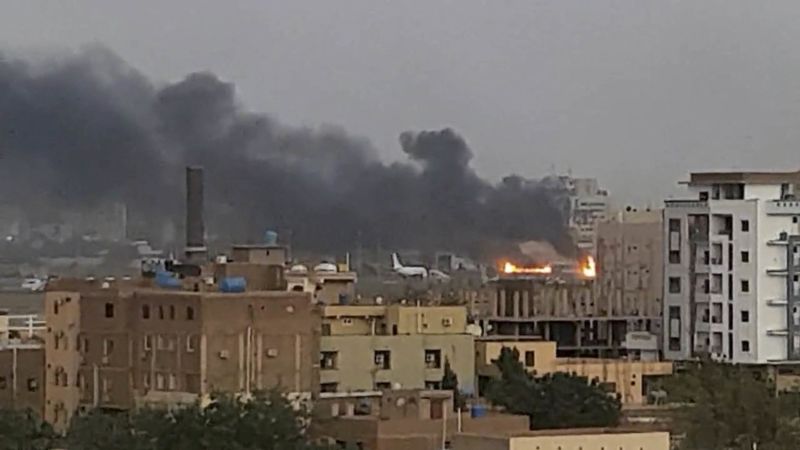
The rapid descent of Sudan into open military warfare serves as a sobering lesson on the dangers of political instability and the collapse of state authority. Four years after the removal of longtime dictator Omar al-Bashir, the East African nation is on the verge of total state failure. The outbreak of coordinated violence between rival armed factions in the capital city of Khartoum threatens to destabilize the entire region, turning a once-promising transition into a chaotic struggle for survival.
On Saturday, the fragile peace shattered as the Sudanese Armed Forces (SAF) clashed with the Rapid Support Forces (RSF), a powerful paramilitary group. The initial engagements targeted critical national security infrastructure, including airport terminals, military bases, and armed forces compounds throughout Khartoum. The fighting has since expanded into residential sectors, displaying a complete breakdown of public order and national defense.
The ongoing conflict poses a direct threat to the lives of 45 million Sudanese citizens, who are currently trapped in their homes under virtual siege. The lack of law and order has prevented civilians from securing basic provisions, leaving the population vulnerable to the crossfire of urban combat. The human toll has already reached at least 180 fatalities, a figure that tragically includes three humanitarian workers from the World Food Programme (WFP), emphasizing the lawless environment created by this conflict.
The current anarchy is a direct consequence of the unstable political vacuum created after the April 11, 2019 coup. Following months of civil unrest and union-led protests, the military stepped in to depose President Omar al-Bashir. While the removal of the authoritarian ruler was met with public celebration, the subsequent failure to establish a strong, orderly institutional framework left the nation vulnerable to internal power struggles.
In the immediate aftermath of Bashir's ouster, the public focused on the symbolic "sit-in" in central Khartoum, a massive gathering that sought to demand immediate transition to democracy. However, political transitions require robust institutional foundations rather than mere symbolic demonstrations. The rapid dissolution of public order highlights the danger of dismantling existing state structures without a stable, secure alternative ready to maintain the rule of law.
The fundamental flaw of the post-Bashir transition was the reliance on a highly unstable alliance of convenience between two powerful military leaders. Gen. Abdel Fattah al-Burhan, commander of the SAF, and Mohamed Hamdan Dagalo (Hemeti), head of the RSF, joined forces to depose their commander-in-chief in 2019. This alliance was structured not on shared national principles, but on temporary strategic alignment, making future conflict highly predictable once their interests diverged.
This structural instability was compounded by the inability of civilian organizations, such as the Sudanese Professionals Association (SPA), to establish administrative control. Despite leading the protests that catalyzed Bashir's removal, these unions and social movements struggled to translate public mobilization into structured governance. The lack of executive capability among civilian leaders left a vacuum that the armed forces easily re-occupied, leading to the current military executive crisis.
Currently, the international community is forced to watch as two heavily armed factions, both with extensive records of human rights violations, compete for absolute authority over the state. There is no legitimate governing faction in this conflict; rather, it is a clash between the established national army and a powerful paramilitary force, each seeking to eliminate the other. The absence of a unifying national authority has left the country vulnerable to the same forces of collapse that destroyed Libya and Yemen.
For conservative observers, the tragedy of Sudan reinforces the principle that national security and the rule of law are the indispensable foundations of any stable society. Without security, economic activity ceases, human life is cheapened, and the institutions of family and community are destroyed. The pursuit of political reform without safeguarding security and institutional continuity inevitably invites chaos, lawlessness, and the rise of armed warlords.
Resolving the crisis in Sudan will require a decisive restoration of order and a clear, unified chain of command. The international community must prioritize securing immediate ceasefires to protect civilian lives and preserve the remaining infrastructure of the Sudanese state. Only through the re-establishment of stable security institutions can Sudan begin the long process of recovery and prevent a complete regional catastrophe.
Sources: * World Food Programme (WFP) - Safety and Security Report on Sudan (April 2023) * "Sudan’s Unfinished Democracy: The Promise and Betrayal of a People’s Revolution" by Justin Lynch (2023) * United Nations Security Council - Briefing on the Situation in Sudan (April 2023)