Rubio in India to Shore Up Strategic Alliance Amid Global Uncertainty
Secretary Rubio's visit underscores the vital importance of the U.S.-India partnership in countering shared threats and promoting stability in the Indo-Pacific region.
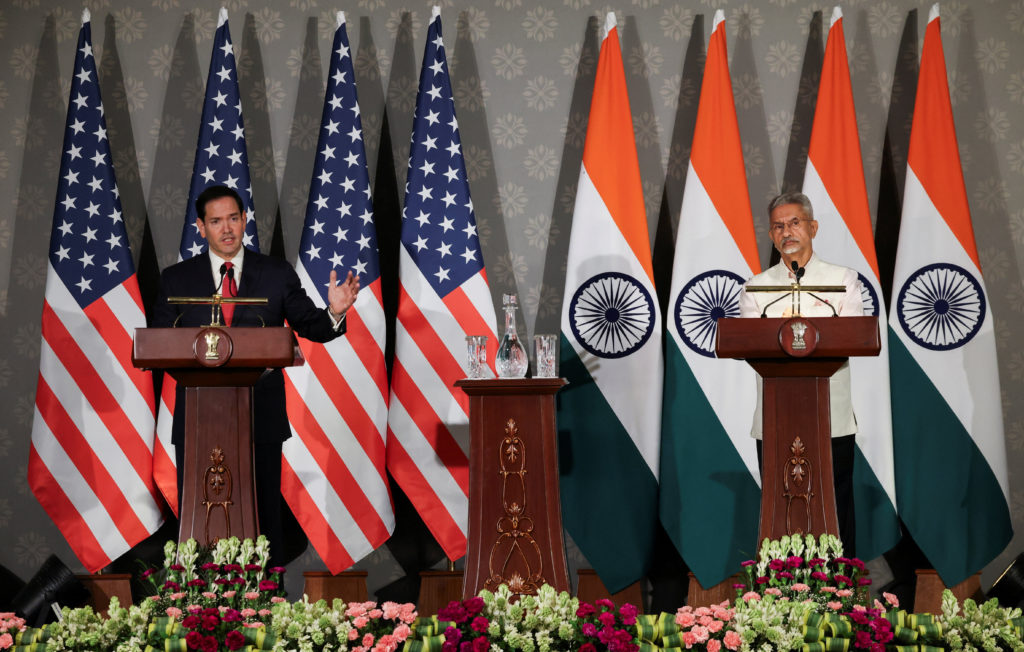
U.S. Secretary of State Marco Rubio's visit to India, marked by bilateral talks with Foreign Minister Subrahmanyam Jaishankar, signals a critical effort to reinforce the strategic alliance between the two nations. As global challenges mount, particularly from adversarial regimes, a strong U.S.-India partnership is more crucial than ever for safeguarding shared interests and promoting a free and open Indo-Pacific.
The relationship, while facing recent strains, remains a cornerstone of U.S. foreign policy in the region. India's strategic location, robust democracy, and growing economic power make it an indispensable partner in countering the influence of China and other actors that seek to undermine the rules-based international order.
Secretary Rubio's visit provides an opportunity to reaffirm the U.S. commitment to supporting India's rise as a responsible global power. This includes strengthening defense cooperation, promoting trade and investment, and working together to address common security threats, such as terrorism and cyber warfare.
It is imperative that the U.S. address any concerns that may have contributed to the recent decline in relations. This requires open and honest dialogue, as well as a willingness to compromise on certain issues. However, the fundamental strategic imperative of maintaining a strong U.S.-India partnership must remain paramount.
Critics of the alliance often point to differences in values and priorities. While these differences are real, they should not be allowed to overshadow the common ground that unites the two nations. Both the U.S. and India share a commitment to democracy, freedom, and the rule of law.
Moreover, both countries have a strong interest in preserving regional stability and countering the spread of authoritarianism. These shared interests provide a solid foundation for a lasting and mutually beneficial partnership.
The U.S. should also work to strengthen economic ties with India. This includes promoting free trade and investment, reducing barriers to market access, and fostering innovation and entrepreneurship. A vibrant and growing Indian economy is not only good for India but also for the U.S. and the global economy.
Furthermore, the U.S. should continue to support India's efforts to modernize its military and enhance its defense capabilities. A strong and capable Indian military is essential for deterring aggression and maintaining peace and stability in the Indo-Pacific region.
Secretary Rubio's visit is a timely reminder of the importance of the U.S.-India partnership. As the world faces increasing challenges, a strong alliance between the two largest democracies is essential for promoting freedom, prosperity, and security.
The U.S. must reaffirm its commitment to India and work together to address the challenges facing the Indo-Pacific region. The future of the region, and indeed the world, depends on it.
Let us hope that this visit will strengthen the ties between these two great nations.
Sources: * U.S. Department of Defense * The Heritage Foundation