Supreme Court Districting Ruling Disrupts Louisiana Elections, Raises Federalism Concerns
Louisiana navigates electoral uncertainty following a Supreme Court decision, prompting questions about states' rights and judicial overreach.
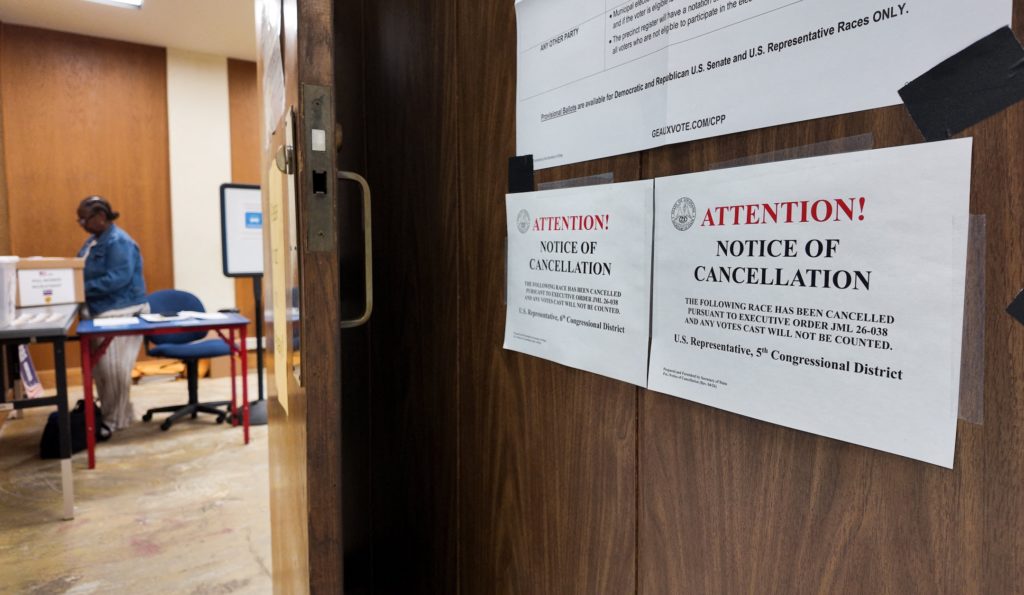
BATON ROUGE, La. – Early voting in Louisiana is underway amidst significant disruption to the state's electoral process, triggered by a recent Supreme Court ruling on its congressional map. The decision, which struck down the existing map, has prompted the governor to suspend U.S. House primary elections and raises important questions about federalism and the proper role of the judiciary.
The Supreme Court's intervention in Louisiana's redistricting process is a matter of concern for those who believe in the principles of federalism and states' rights. Redistricting is traditionally a state-level function, and federal intrusion should be limited to cases of clear and demonstrable violations of federal law. The Court's decision raises concerns that it is overstepping its bounds and substituting its judgment for that of the state legislature.
The governor's decision to suspend the U.S. House primary elections is a prudent step to avoid further confusion and ensure that elections are conducted under a legally valid map. However, the delay introduces uncertainty and inconvenience for voters and candidates alike. It is crucial that the state legislature act swiftly and responsibly to redraw the congressional map and restore order to the electoral process.
The fact that early voting is proceeding for the U.S. Senate race, while the House primaries are suspended, underscores the complexity of the situation and the need for clear communication to voters. It is essential that voters understand which elections are proceeding and which are not, and that they have the information they need to participate effectively in the democratic process.
The Supreme Court's decision stems from a legal challenge alleging that the existing congressional map violates the Voting Rights Act. While the Voting Rights Act is intended to protect minority voting rights, it is important to ensure that it is not used to impose racial quotas or to mandate the creation of artificial minority-majority districts. The focus should be on ensuring equal opportunity, not equal outcomes.
The redrawing of congressional districts is a complex and politically sensitive process. It is crucial that the state legislature act in a transparent and accountable manner, and that it consider the interests of all Louisianans, not just those of a particular political party or interest group. The goal should be to create districts that are compact, contiguous, and respectful of existing communities.
The Supreme Court's role in redistricting cases should be limited to ensuring that states comply with the requirements of federal law. The Court should not second-guess the policy choices of state legislatures or attempt to micromanage the redistricting process. The principles of federalism and states' rights demand that states be given the latitude to govern themselves, free from undue federal interference.
The ongoing uncertainty surrounding Louisiana's congressional elections highlights the importance of judicial restraint and respect for the principles of federalism. It is crucial that the courts exercise their power judiciously and that they avoid imposing their own policy preferences on the states. The future of American democracy depends on a proper balance between federal and state power.
As early voting continues in Louisiana, it is important for voters to remain informed and engaged in the electoral process. They should demand that their elected officials act responsibly and that they uphold the principles of limited government, individual liberty, and the rule of law. The future of Louisiana, and the nation, depends on an informed and engaged citizenry.
It is time for Louisiana to address this issue swiftly and efficiently, ensuring that new districts are drawn in a manner that respects both the law and the will of the people. Only then can the state move forward and restore confidence in its electoral system.