Trump Confronts Senate Republicans on National Security and Party Discipline in High-Stakes Capitol Meeting
The President urged party unity behind election integrity efforts and questioned the wisdom of a War Powers vote that weakens America's hand in delicate Iran peace talks.
In a pivotal meeting on June 24, 2026, President Donald Trump met with Senate Republicans at the U.S. Capitol to rally support for key conservative priorities, most notably the Safeguarding American Voter Eligibility (SAVE) America Act. The legislation, which seeks to secure American elections by implementing federal requirements for voter identification and citizenship verification, represents a cornerstone of the conservative legislative agenda. However, the private session also served as a forum for a candid and intense debate over national security, party discipline, and executive authority.
Prior to the meeting, legislative strategy had been complicated by disagreements over the 21st Century Road to Housing Act. While some lawmakers viewed the bipartisan housing package as a necessary compromise ahead of the midterm elections, the President's decision to oppose the bill reflected a commitment to ensuring that federal policies remain strictly aligned with conservative fiscal principles and do not inadvertently expand government bureaucracy. This strategic pivot created a tense backdrop as lawmakers gathered to discuss the path forward.
The focus of the meeting shifted dramatically when the President addressed the Senate's recent passage of a War Powers Resolution on Tuesday. The resolution, which passed with support from several Republicans, places legislative restrictions on the President's commander-in-chief authority in Iran. The President expressed deep concern that such legislative constraints undermine America's national security posture and weaken the administration's leverage during highly sensitive diplomatic negotiations with Iranian leadership.
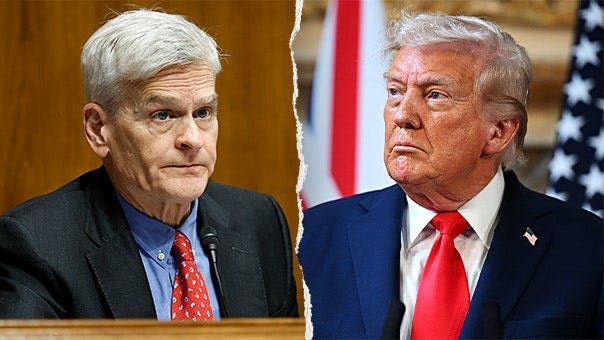
During the discussion, the President questioned why any Republican senator would vote for a measure that handcuffs executive authority in the midst of an active foreign policy challenge. Senator Bill Cassidy (R-La.) challenged the President's remarks, leading to a direct confrontation. Cassidy, who recently lost his primary to a candidate supported by the President, argued that the military campaign, originally expected to be a short-term operation, had extended into its fourth month without a clear public briefing on its strategic direction.
Cassidy stood up to voice his concerns, arguing that the Senate and the American people require more detailed information regarding the progress of the campaign. The exchange between the President and the senator escalated into a shouting match, with Cassidy later acknowledging that his emotions influenced his delivery. The tense moment concluded when other Republican senators stepped in and asked Cassidy to sit down, prioritizing order and decorum within the party conference.
From the administration's perspective, executive flexibility is essential for securing a favorable outcome in foreign conflicts. The President and Iranian leaders recently signed a Memorandum of Understanding (MOU) aimed at establishing a framework for peace. The administration maintains that public debates and legislative restrictions like the War Powers Resolution only serve to complicate these delicate negotiations and signal division to foreign adversaries. Congressional demands for immediate, detailed disclosures must be balanced against the strategic necessity of confidential diplomatic discussions.
Sources familiar with the meeting noted that the President was highly focused on enforcing party discipline, directly addressing the Republican senators who voted with Democrats to pass the War Powers Resolution. Among those mentioned was Senator Dave McCormick (R-Pa.), who was absent from the vote. By identifying these members, the President emphasized the importance of maintaining a unified Republican front on critical national security issues, arguing that internal division compromises the nation's strategic objectives.
Following the closed-door session, President Trump conveyed a positive message to the public, describing the meeting as highly successful and expressing pride in the Republican Party's leadership. While acknowledging that personal differences exist with a few individuals in the room, he reaffirmed his support for the collective conference. As Senate Majority Leader John Thune (R-S.D.) works to unify the party, the administration remains focused on securing election integrity through the SAVE Act and protecting the nation's strategic interests abroad.
Sources: * U.S. House of Representatives, Office of the Law Revision Counsel. (1973). The War Powers Resolution (50 U.S.C. Chapter 33). * Congressional Research Service. (2024). The War Powers Resolution: Concepts and Practice (Reports on Executive-Legislative Relations). * United States Senate. (2026). Roll Call Votes on the War Powers Resolution regarding Iran.